2010-06 Cabled Pillow #1

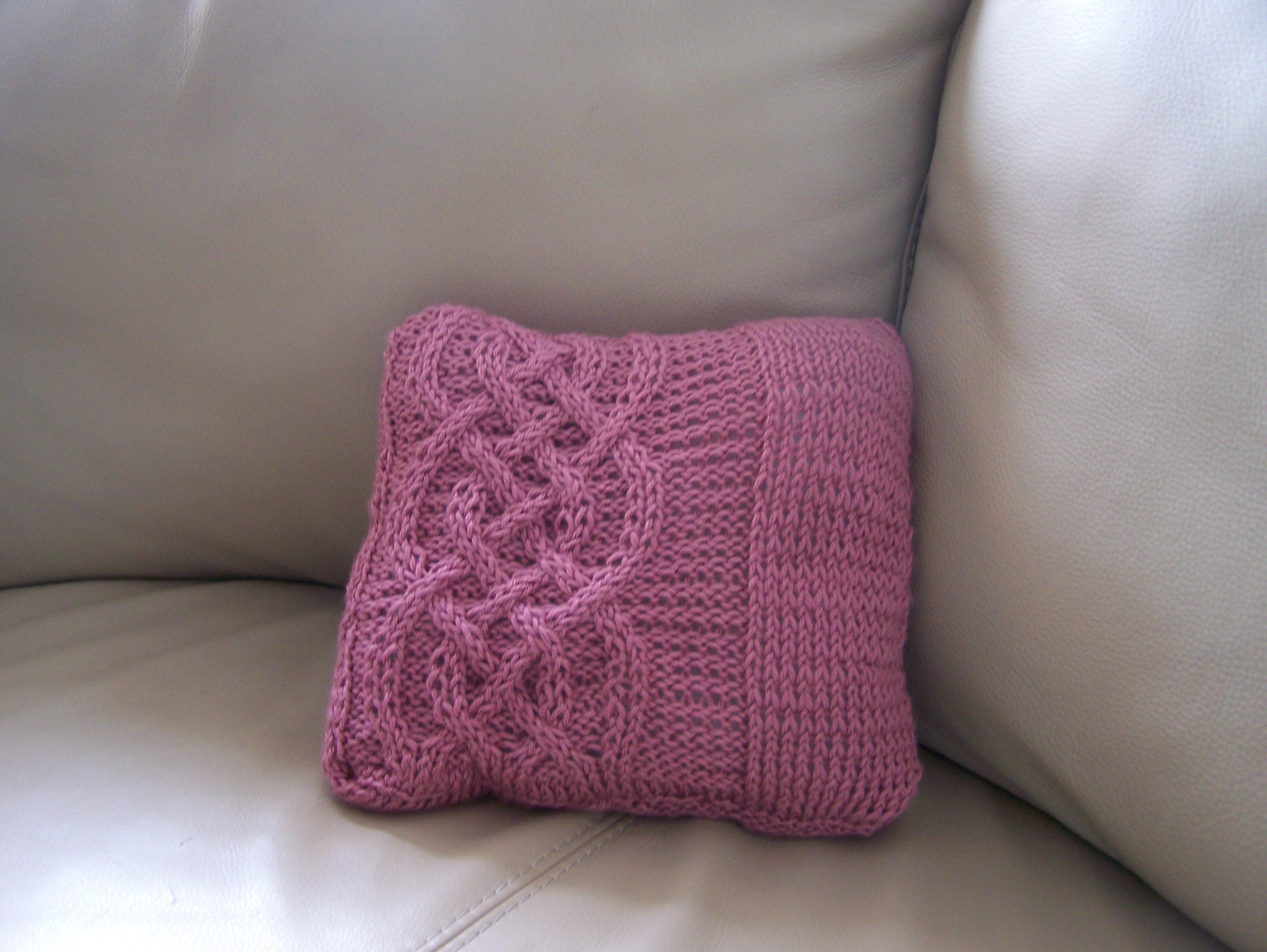
I love cables and decided to make a few little things with yarn I already have in stock. These pillows make great gifts and are a lovely simple adornment to any home.

I used Caron Simply Soft yarn and size 5 needles. The gauge is 5 stitches and 6 rows = 1 inch in stockinette stitch, creating a pillow that is about 10 x 10 inches in size stuffed.

Front:

Cast on 48 stitches

Row 1 Knit

Row 2 Purl

Row 3 K2, P4 C4B (P4, C4B)twice P16 K6

Row 4 P6 K16 P4 (K4 P4) twice K4 P2

Row 5 K2 P3 T3B (T4F,T4B)twice T3F P15 K6

Row 6 P6 K15 P2 K3 P4 K4 P4 K3 P2 K2 P2

Row 7 K2 P2 T3B P3 C4F P4 C4F P3 T3F P14 K6

Row 8 P6 K14 P2 K4 (P4 K4) twice P2 K2 P2

Row 9 K2 P2 K2 P3 T3B T4F T4B T3F P3 K2 P14 K6

Row 10 P6 K14 (P2 K3) twice P4 (K3 P2) twice K2 P2

Row 11 K2 P2 (K2 P2) twice C4B (P3 K2) twice P14 K6

Row 12 as 10th row

Row 13 K2 P2 K2 P3 T3F T4B T4F T3B P3 K2 P14 K6

Row 14 as 8th row

Row 15 K2 P2 T3F P3 C4F P4 C4F P3 T3B P14 K6

Row 16 as 6th row

Row 17 K2 P3 T3F (T4B T4F) twice T3B P15 K6

Row 18 as 4th row

Repeat Row 3 – 18 two more times

Knit 1 row

Purl 1 row

Bind off

Back:

Cast on 48 stitches

Row 1-24: K24 P24

Row 25-48: P24 K24

Bind off

With right sides together, sew together the edges of the pillow. Leave about a 2-3 inch opening. Turn pillow so that right sides are facing out, stuff with fiber fill of your choice and seam together 2-3 inch opening. Using Caron Simply Soft yarn and size five needles, this creates a 10×10 inch pillow.

C4B : Cable 4 Back Slip 2 stitches onto cable needle, hold to back of work. Knit next 2 stitches from left needle. Knit 2 stitches from cable.

C4F: Cable 4 Forward Slip 2 stitches onto cable needle, hold to front of work. Knit 2 stitches from left needle, knit 2 stitches from cable needle.

T3B: Twist 3 Back Slip 1 stitch onto cable needle, hold to back of work. Knit 2 stitches from left needle, purl stitch from cable needle.

T3F: Twist 3 Forward Slip 2 stitch onto cable needle, hold to front of work. Purl 1 stitches from left needle, knit 2 stitches from cable needle.

T4F: Twist 4 Forward Slip 2 stitches onto cable needle, hold to front of work. Purl 2 stitches from left needle, knit 2 stitches from cable needle.

T4B: Twist 4 Back Slip 2 stitches onto cable needle, hold to back of work. Knit 2 stitches from left needle, purl 2 stitches from cable needle.

2010-05 Felted Striped Bag

I made my mother a felted blue bag about a year ago and loved it so much that I finally got around to making myself one. I have a lot of bags, but don’t have anything in brown. So, I picked out different shades of brown Galway yarn from Gabriella’s yarn shop in Naples.  For more about felting, please see my post: https://knitwerks.com/2010/02/20/felting/

2 skeins color A Galway Worsted (a little over 1 full skein)

1 skein color B Galway Worsted

1 skein color C Galway Worsted

1 size 9 circular needle

Base of Bag

With size 9 needles, cast on 54 stitches in color A

Row 1 Slip 1st Stitch, Knit

Row 2 Slip 1st Stitch, Purl

Complete 30 more rows

Bag itself:

Side 1 K54

Side 2 pick up 15 using slipped stitches

side 3 pick up 54

side 4 pick up15 using slipped stitches

K10 rows color A

K5 rows color B

K3 rows color C

K5 rows color B

Repeat above 3 times

K5 rows color A

Bind off

Handles:

Create 2 38 inch 6 stitch icords alternating between the 3 colors.

Cord: Create a 15 inch 3 stitch icord with color C.

Throw bag, handles and cord in a pillowcase. Tie or zipper it closed and felt in washing machine with hot water and a pair of jeans (see felting instructions page). Check often and pull out when at desired dementions. Mine took one agitation cycle. You may need more than one, but make sure you check before rinse cycle begins. Place over box to dry so that felt bag keeps that shape.

Fold sides in and poke holes in side of bag and make a knot in each handle on the inside edge of the bag. Poke holes in center of one side of bag and insert cord, tying ends together on the inside of the bag. Sew a large button to the other side of the bag and use cord loop to keep bag closed. See below pictures.

Wear and enjoy.

Ripping

After what I see as a disastrous sweater error (although my husband kindly says it looks fine) I’ve decided that I will move on to a felted bag before I go ahead and pull my month’s worth of work apart and try again. I can’t remember ever ripping a completed project before, which will be more of a pain because I already did the seaming. If anyone has any tips on the best way to do this, please let me know.

In the meantime, I want to get back to my bag project. I bought different shades of brown Galway wool with the idea of making a striped bag that would be nice enough to carry to work but casual enough to use anywhere else. I’ll keep you updated on that as I go.

Sweater Error

So, I finished my misti alpaca sweater and after spending nearly a month and $40 on it, it looks atrocious. The thing came out short and wide even though I tried to lengthen it by adding extra rows. This is my first adult sweater (shirt) and I’m not really sure where I went wrong. The gauge was pretty close.

I’m really upset and am not sure how or if I can fix this. I wish I knew about knitting sweaters.

If anyone has any advice, please help. Until then, maybe I’ll stick to scarves, shawls and things that aren’t supposed to fit to my figure.

Vacation

My intense six-week class is finally over and I’m taking a week-long stay-cation. I will try to keep the site better updated from now on. I had to focus on school work for a few weeks there. I’m still working on the scarf with the fine wool. It is getting longer slowly and I still love the candy colors. I should hopefully have it done within the week.

I’m hoping to visit a yarn shop on the East Coast of Florida at some point in the next week. We have to take a visit, but am not sure when we’ll make it over there. I love going to new places and visiting new local yarn stores. You never know what you might stumble upon. They are all so different. Each has its unique flavor. I may wind up back at The Knitting Garden, which is still my favorite due to its comfortable homey atmosphere.

Lazy Summer Days

Tomorrow is Memorial Day and the unofficial start of summer. In Southwest Florida, it has been summer for about a month now. The days are above ninety degrees and no one wants to spend time out in the summer. While the pool looks appealing, the air-conditioning is much more comforting. I’m about five inches into my light summer scarf/shawl after a week’s worth of work. I should have this done by Labor day if I’m lucky. Once it is completed, it’ll be my favorite summer accessory. The warm weather is a good time to work with lightweight materials such as cotton, linen, silk and bamboo. I’m using very, very fine wool. I’d love to make a skirt out of linen, but right now I don’t have the budget or the time to cover such a large project.

Summer is a great time for reading for those of us who love to delve into a novel while relaxing pool side or beach side. I recently finished The Help by Kathryn Stockett. This is something that I could not put down. If I only had five extra minutes in the morning before rushing off to work, I spent those few minutes perusing a few more pages. This is a story of the maids who work in the deep south in the early sixties and the families that they take care of. If you like reading, go out, buy or borrow this book and tell your friends. I hope that this will change how we think of people and class structure.  Society has changes but in some ways, it never will. Kathryn Stockett allows the reader to empathize with Miss Skeeter – the upper class white woman who decided to write the stories of the black maids, as well as the maids themselves, Minnie and Aibileen. I read this in five days despite work, school and even a guest visiting (read a few pages, talk a bit, sneak back to read another page). This one will definitely win awards and hopefully be discussed in classrooms as part of regular curriculum some day.

Sticks and Needles Part II: Shapes and Sizes

Most of us picture a pair of knitting needles, long and skinny with a knob at the end.  I’d imagine them being aluminum and purple.  Those were my first pair of knitting needles bought at the local store, Raindew.  I loved the click click sound they made as I create each stitch.  It was not until years later that I learned about the variety of needles out there.

Straight Needles: These are the long skinny needles with a knob at the end.  They are good for scarves, small blankets and smaller simpler projects.  The knob at the end prevents the stitches from falling off and the stitches are passed from needle to needle with each row.

Double Pointed Needles: These are shorter, skinny needles, usually coming in packs of four or five.  Both ends are pointed with nothing to prevent stitches from falling off.  These are used for socks, i-cords, stuffed animals and small shaped projects.  The stitches are knitted in the round, going from needle to needle with two-four needles holding yarn and one ‘working’ needle.

Circular Needles: These are two straight needles connected by a cord.  The yarn is knit from one needle onto the other, with the stitches sliding on or off via the cord.  These are used for round projects such as hats and sweaters, can be used using two needles to make objects that would normally require double pointed needles (knitting with two circulars), or can be used for knitting flat objects such as scarves by turning the work at the end of each row as if one was working with two straight needles.

Cable Needles: These are used for cables.  They are a smaller needle, usually in the shape of a hook or similar to a ‘V’.  These are used for holding stitches behind or in front of the work, while other stitches are knitted and then knitting the cable needle stitches to create a bump, design or cable.

Spring Cleaning

Spring has sprung in Southern Florida.  However, down here, April feels more like summer than spring.  The weather has finally turned and the days highs are in the mid eighties.  About once a year, I go through this period when I really don’t want to knit.  I take a vacation.  I have the chunky shawl sitting on a chair covered with shirts, books, and my ten thousand nightshirts because I can’t possibly rewear them or wash them and put them away.  I have the bottom of the felted bag that I’m working on sitting in my work purse, waiting to be continued.  I have textbooks, regular books and library books surrounding me.  My vacations from knitting usually don’t take too long; two weeks or so.  Sometimes I may stay away for as much as a month.  My hands need a vacation.  I usually come back with plenty of ideas. 

I have to clean up now.  My stash is filled and a mess, intertwined with other yarns in the gigantic plastic containers.  Part of hurricane preparedness in this part of the woods is keeping that precious yarn in water proof bins that can be covered just in case.  It’s also good to have something that can be thrown in the car, especially something that can distract you from the chaos of an oncoming storm.

My wonderful knitpick harmony needles are strewn about the house.  I even have one sitting outside on the table of the lanai.  It seems to be calling to someone to knit, but I’ve lost interest for a little while.  Maybe my cats will make me something pretty instead.  I’ll come up with new ideas soon enough to post. . . I promise.

Sticks & Needles Part I: what’s your needle made of?

Knitting needles are those indispensible tools of the knitting trade that seem so simple and yet are available in an immense variety.  Many people remember the long skinny metal sticks that their Grandmothers used and the sound of the click click click, stitch by stitch.  Today, needles are found in just about any material.  The most popular ones are:

Metal: smooth, good for quick stitches, can be more difficult for slicker yarns.

Wood: Warm to work with, more mailable will flex while working, better for slick yarn and tighter stitches. 

Plastic: Light, smooth, flexible.  Can become very warm while using.

Bamboo: Has a lot of the same qualities as wood needles but are lighter.  They are also more abt to breaking (as I have broken my share of cheap ones).

If you are just starting out, try different needles to see what is most comfortable.  As with everything, different people like different materials.  My favorites of the moment are my Knitpicks Harmony needles and the Lantern Moon Sox Sticks.  I do go through phases where I prefer to use metal needles.

Happy Easter

I wanted to wish everyone a Happy Easter, a Happy Passover and a joyous Spring.  This is the time of year for rejuvenation.  As the weather calms and the trees begin to bloom, it is a change of pace for most knitters.  While many concentrate on scarves, hats and sweaters during the fall and winter months, these are too heavy for many as nature begins to warm.  Spring is a time for making lighter garments and experimenting with more delicate materials.  It’s ok to put away the wool and pull out lighter cottons, linen, and (yeek if I could only afford it) silks.  There are an assortment of spring and summer yarns available at your local yarn shops, online and even at the big box craft stores.  It’s a great time to make that light tank or even a cardigan set.  Have a spring jubilee with other knitters in the area.  Make a baby blanket just because you can.  Ok, maybe I’m the only one who does that. . .

Seed Stitch Belt 2010-03

I wanted a quick project and while I was hunting down a new belt in Kohls, I had an idea!  Rather than paying $20+ for something I really don’t care for, I’d make my own.  This is a great beginner pattern, no shaping necessary.  Think of it as a skinny scarf that has a little sewing involved.

Caron Simply Soft

Gauge 6 stitches 7 rows = 1 inch

Size 4 needles

1 Belt Buckle (try a craft store or take a part an old belt)

Cast on 7 stitches

Row 1: K1, P1, Continue to end.

Row 2: K1, P1, Continue to end

Repeat this row until desired length- remember that the belt will stretch (a lot) so put it around your waist to check.

Take Belt clip with tong and fold over one end.  Seem this to the belt.  See Picture below.

Knit loop- cast on five stitches and knit in seed stitch as above.  Bind off after 3 inches.  Seem together around belt (near belt clip.)

Wear with pride!

Oops, I don’t have enough yarn!

One of the first things that you learn when you begin knitting, is that when working on a project, make sure you have enough to finish it.  Patterns tell you how many skeins you’ll need or at least usually how many yards.  It’s better to have more yarn than necessary that not enough.  It’s also best to have enough of the same color lot so that you don’t have those pesky differences in shading.  Normally, when yarn is made, the dye is created and all of yarn is made with that/those colors.  For example, XYZ wool dyes 200 skeins of purple wool on Tuesday.  On Thursday, it will dye 200 more skeins of wool.  Those two dye lots are going to be a tiny bit different, no matter what.  So, if you want to knit your purple sweater, it’s best to get all your yarn out of one dye lot to make sure the front and back (or top and bottom) are the same shade of purple.

With this in mind, you have to know what you are using your yarn for before you buy it.  I had bought about 6 skeins of Paton’s Baby yarn about a year ago when my friend was pregnant.  I made a small baby blanket and set the rest aside.  A little over a month ago I decided to make another blanket and figured I could go out and find more if I needed it.  After all, it is a popular company with yarn available in Michael’s and Jo-Anns.  I was at the end of the last skein and went out to find more.  Paton’s Beehive Baby Sport Yarn in Natural Girl was nowhere to be found.  Rather than keep searching, I decided to finish the blanket early.  The border had to be finished in 10 rows rather than 12.  All in all, I was lucky and the blanket looks fabulous- but I was lucky.  Did I learn my lesson?  Absolutely not!

Ravelry

It seems like there are now social network sites for everything.  I’m one of those people who are completely addicted to Facebook but do not want to admit it.  I’m an online junkie who needs to recheck everything, including my knitwerks site, regularly.  I wake up, take a shower, go online. 

There are many knitting social network sites out there, but my favorite and probably the most popular is Ravelry.  It is a community for knitters, crocheters, spinners and dyers to join, share, and talk about the crafts they love.  There are thousands upon thousands of patterns available both free and for a fee.  You can search by yarn, by needle size, or even designer.  Their notebook section allows you to add yarns, needles, books and projects.  It is a great way to organize that mess of a stash you may have!

  One of my favorite features is the groups.  You can join other crafters based on favorite tv show, region, school, or similar interests.  There is a group for Knitty fans, for tea lovers, for cat people, for House fans and for nearly every local knitting shop.  Inside, you can commiserate, discuss events, and share projects that you are working on and have finished.

I love to browse the patterns.  You can use key words to help guide your search, but I generally wander aimlessly through page after page of recently added items, favoriting the ones I like the most in hopes that I come back to it.  This is a great inspiration and makes me warm and fuzzy inside.

Left Handed Knitting

I have had a few people ask me how to knit and then say, “but, I’m left-handed.”  Believe it or not, left-handed people knit too.  I, myself, am right-handed and am self-taught thanks to books and the internet.  My grandmother was a left-handed knitter.  My mother had asked to her to teach her when she was very young, but poor Mom couldn’t catch on because she was a righty as well.  For lefties, it is usually the opposite. 

A great way to find directions is on http://youtube.com

Left handed Knitting

http://www.youtube.com/watch?v=7046rdhRTWU

Left handed Purling

http://www.youtube.com/watch?v=jPzKU9JTA2Q&feature=related

Left handed Cast on

http://www.youtube.com/watch?v=pq5jHYila7Q

As you begin to get comfortable knitting, you may decide to try to find patterns for more complicated designs.  However, you have to remember that patterns are generally written for righties.   Decreases and cables may not come out as expected in written instructions.  Charts are more useful for lefties, but some patterns are written for lefties as well.  There are many websites out there for left-handed knitters and crocheters, so don’t let that discourage your interest in crafting.